
Masonry in Newton, MA: A Village by Village Guide for Homeowners
· By Clemente Neto
Newton is one city, but it does not feel like one place. It is made up of 13 villages: Auburndale, Chestnut Hill, Lower Falls, Newton Centre, Newton Corner, Newton Highlands, Newtonville, Nonantum, Oak Hill, Thompsonville, Upper Falls, Waban and West Newton. Many grew around railroad stations in the 1800s, and each has its own mix of housing, lot sizes and terrain.
That variety means masonry in Newton is very local. A granite entry in Chestnut Hill, a brick stoop in Nonantum and a retaining wall on a ledge lot near Oak Hill are different projects with different rules. This guide breaks down what to expect.
Four local historic districts, four commissions
Newton has four local historic districts covering roughly 775 properties in total. Newton Upper Falls was the first, created in the mid 1970s to protect one of the earliest villages and its early industrial center. Chestnut Hill followed in 1991 with about 250 properties, Newtonville in 2002 with over 100, and Auburndale in 2005 with about 275.
Each district has its own Historic District Commission, working with the Planning and Development Department and the Newton Historical Commission. If your property is inside one, exterior masonry changes visible from a public way, such as new steps, walls, walkways or chimney work, generally need approval before a building permit. Newton also has a demolition review process for older buildings, so removing a chimney or a significant part of a structure is worth checking with the city first, even outside the districts.
Ledge and puddingstone
Newton sits on Roxbury Conglomerate, better known as puddingstone, a rock studded with rounded pebbles. You can see it in the ledges at the Webster Conservation Area near Hammond Pond, the largest conservation area in the city. In neighborhoods near that ledge, it is common to hit rock when digging.
For masonry, ledge changes the plan. A retaining wall or set of steps may need its footing set on or pinned to rock rather than dug below the frost line in soil, and excavation can take longer. Ledge also affects drainage, since water runs along the rock surface and can collect behind walls. A site visit before quoting is essential on these lots.
Ledge can also be an asset. Where rock sits close to the surface, a wall or step can sometimes be anchored directly to it, which gives a very stable base. The key is planning for it early instead of discovering it halfway through a dig.
Large homes with granite entries
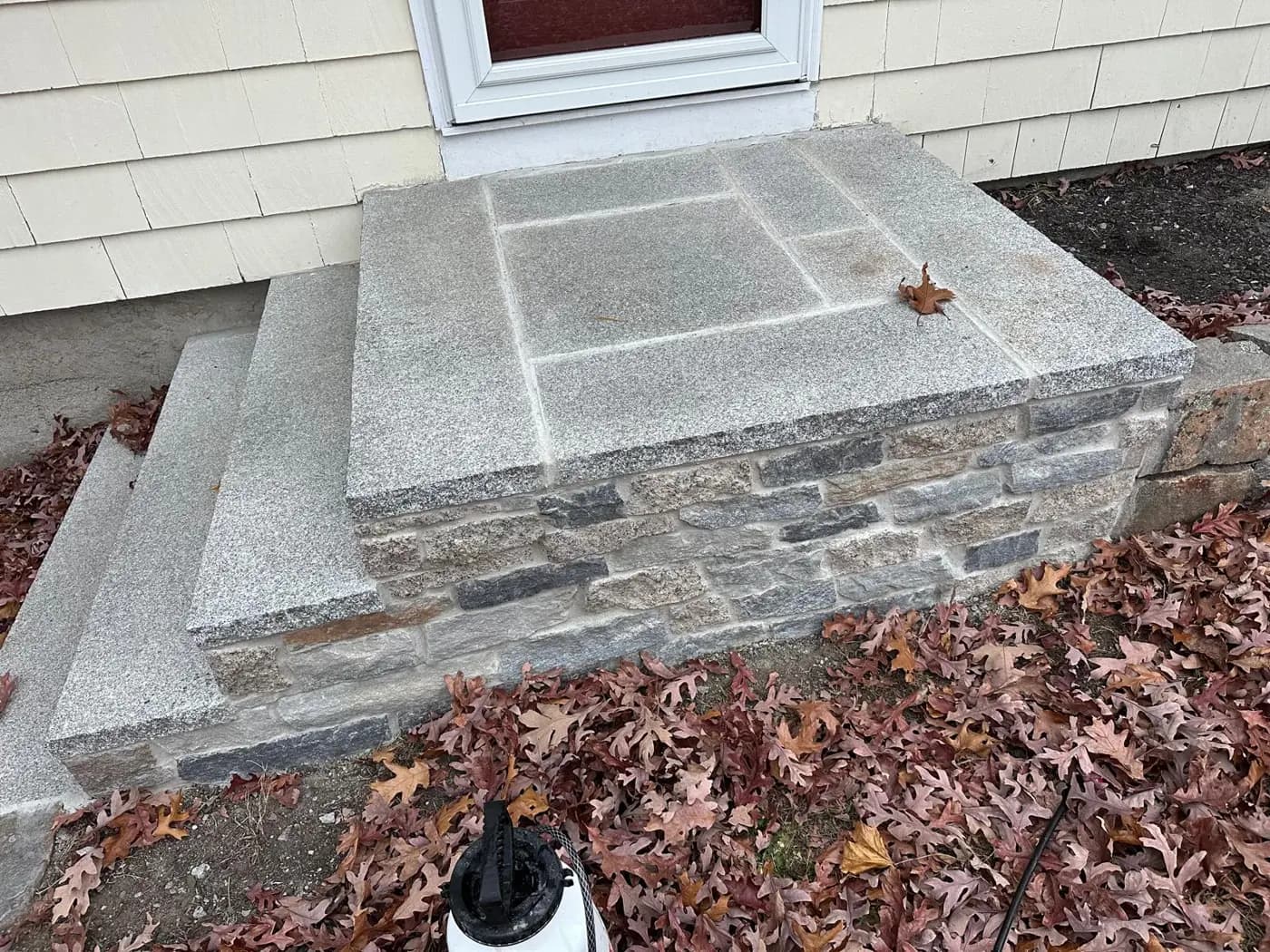
Villages like Chestnut Hill, Waban and Newton Centre have many large older homes with formal entries: granite steps, stone or brick landings, and walkways leading from the street. Granite holds up to salt and frost far better than most materials, but the joints and base still need care. Common issues are shifted treads, open joints between stones, settled landings and railings loosening in their sockets.
Resetting granite treads on a new base, repointing joints and resetting railings can restore an entry without replacing the stone. Where treads are cracked or the design no longer meets safety needs, new granite can be cut to match.
Sloped yards and retaining walls
Newton's hills mean many yards have retaining walls, from low garden borders to tall walls along driveways. Retaining walls are one of the most searched masonry topics in Newton. Failures usually come from water: a wall without drainage stone and an outlet behind it collects water, which freezes and pushes the wall outward.
Signs to watch are leaning, bulging, cracks that grow and soil washing through. Taller walls, often over about four feet, or walls supporting a driveway may need a building permit and an engineered design. In a historic district, the commission may also review materials.
Brick chimneys across the villages
Chimney repair is the single most searched masonry service in Newton. Older homes in nearly every village have brick chimneys that take weather above the roofline: cracked crowns, failing flashing, loose top courses and eroded mortar. Leaks usually show up as stains on an upper ceiling or in the attic.
On older homes, repointing should use a mortar that matches the softness of the original brick. Too hard a mix can damage historic brick over time. A chimney that leans or has many loose courses usually needs to be rebuilt from the roofline up.
Typical costs in Newton
As a rough market guide, chimney repointing and crown repair often fall in the low thousands of dollars, with rebuilds above the roofline costing more on tall or complex chimneys. Granite entry steps commonly range from several thousand dollars to well into five figures for wide entries with landings. Retaining walls are priced by the size of the face, and ledge excavation, drainage and engineering can add significantly.
These are typical ranges, not quotes. Historic review, ledge, access and material matching all affect the price. A free on-site estimate is the way to get a number for your home.
Frequently asked questions
- What are the 13 villages of Newton, MA?
- Auburndale, Chestnut Hill, Lower Falls, Newton Centre, Newton Corner, Newton Highlands, Newtonville, Nonantum, Oak Hill, Thompsonville, Upper Falls, Waban and West Newton.
- Which Newton villages have local historic districts?
- Newton has four local historic districts: Newton Upper Falls, Chestnut Hill, Newtonville and Auburndale. Exterior changes in them generally need approval from that district commission.
- What happens if a contractor hits ledge in my Newton yard?
- Ledge is common in parts of Newton. A footing may be set on or anchored to rock instead of dug deeper, and excavation can take longer. A site visit before quoting helps avoid surprises.
- Do I need a permit for chimney work in Newton?
- A chimney rebuild usually needs a building permit, and removing a chimney on an older building may involve demolition review. Small repairs may not. Check with the city before work begins.
- How do I get a reliable masonry estimate in Newton?
- Book a free on-site estimate. Seeing the masonry, the slope and any ledge in person is the only way to price the job accurately.
Related services
Serving
Found this helpful? Make us a preferred source on Google.
Ready for an exact price?
Get a free, no-pressure in-home estimate. Real numbers for your home, not a phone guess.