
How Much Does Chimney Repair Cost in Massachusetts? (2026 Guide)
· By Clemente Neto
Chimney repair is one of those jobs most homeowners put off until something forces the issue: a water stain on the ceiling, bricks in the gutter, or a home inspector flagging it before a sale. By then the first question is always the same. How much is this going to cost?
The honest answer is that it depends on what is actually wrong. A chimney that needs a few joints repointed and a chimney that needs to be taken down to the roofline are two very different jobs. This guide walks through the typical price ranges Massachusetts homeowners see in 2026, what pushes a quote up or down, and how to tell when a repair still makes sense and when a rebuild is the smarter money.
Why chimneys in Greater Boston wear out
A chimney is the most exposed piece of masonry on your house. It sits above the roofline, takes wind-driven rain from every direction, and goes through dozens of freeze-thaw cycles every winter. Water gets into small cracks in the mortar or the crown, freezes overnight, expands, and slowly pushes the joints and brick faces apart. Repeat that for a few decades and you get loose bricks, open joints and leaks.
Much of the housing stock around Everett, Arlington, Melrose and Newton is 70 to 120 years old, and many of those chimneys were built with softer lime-based mortar or have been patched with the wrong materials over the years. That history matters, because it decides whether the chimney needs a targeted repair or a larger rebuild.
Typical chimney repair price ranges in 2026
As a rough guide, here is what most Massachusetts homeowners see for common chimney work. These are market-typical ranges, not a quote, and they vary with access, height and condition.
Minor repointing (replacing failed mortar in a section of the chimney) typically runs from several hundred dollars up to around $1,500 to $2,500. Full repointing of an entire chimney above the roof often lands in the $2,000 to $5,000 range depending on size. A new or rebuilt chimney crown usually falls somewhere between $800 and $3,000. Flashing repair or replacement commonly runs $500 to $2,000. A partial rebuild from the roofline up is often in the $4,000 to $10,000 range, and a full rebuild of a tall or wide chimney can go well beyond that.
If you see a number far below these ranges, ask exactly what is included. If you see one far above, ask what condition issue is driving it. Either way, the only number that matters is the one you get after someone has actually looked at your chimney.
What drives the price up or down
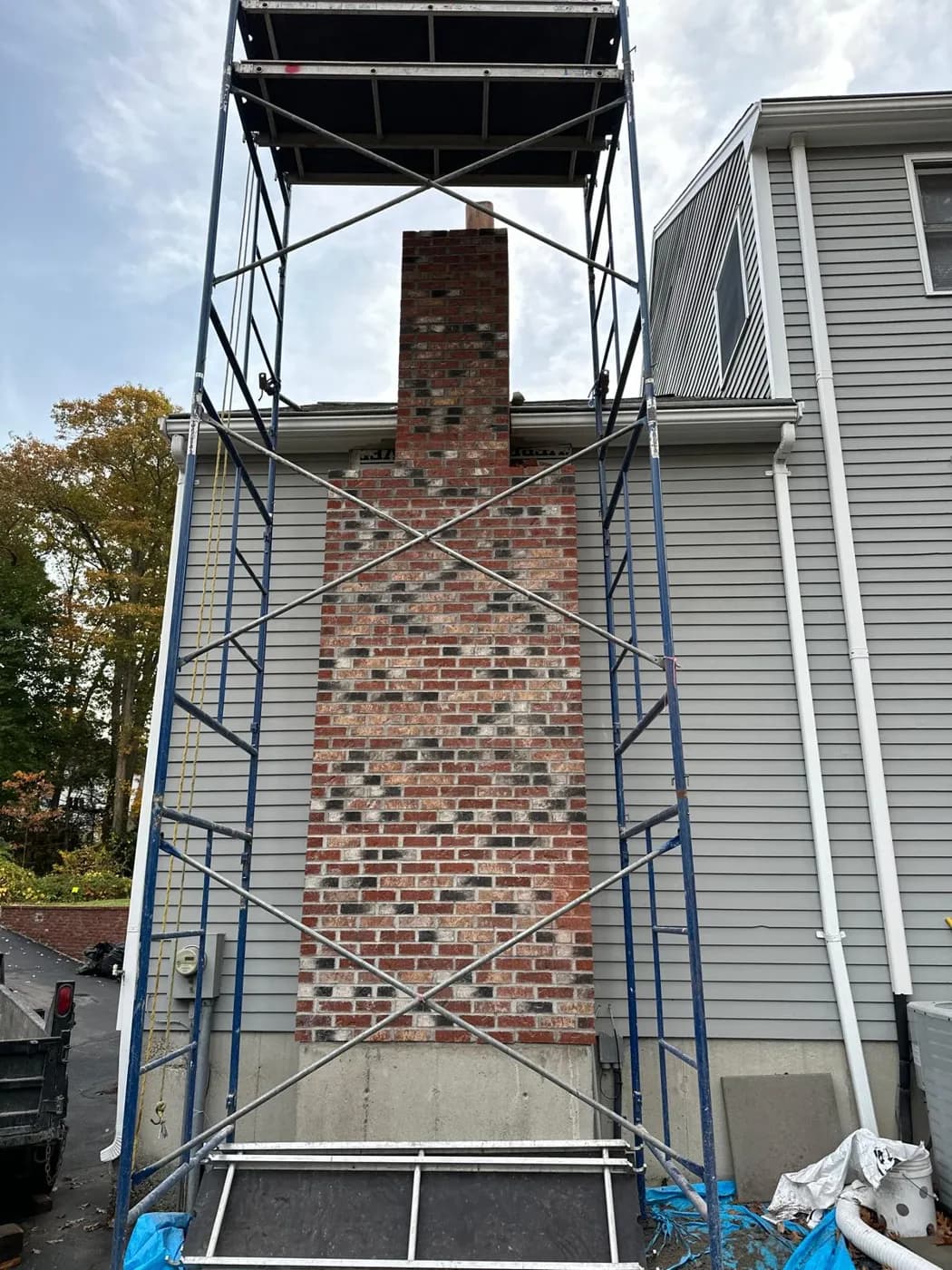
Access is the biggest factor most people do not expect. A short chimney on a single-story ranch can often be reached from a ladder and roof brackets. A tall chimney on a steep three-story roof, common on triple-deckers and Victorian homes, usually needs staging or scaffolding, which adds setup time and cost before a single brick is touched.
Height and size come next. More courses of brick means more mortar to cut out and replace, and multiple flues mean more work at the crown. Condition matters too: if bricks are spalling (the faces are flaking off), they need to be replaced rather than just repointed. Finally, matching materials adds time. Older chimneys often need a softer mortar mix and reclaimed or color-matched brick so the repair does not stand out or damage the original masonry.
Repointing, crown, flashing or rebuild: which one do you need?
Repointing is the right call when the bricks themselves are sound but the mortar joints are recessed, sandy or cracked. The mason grinds out the failed mortar to a consistent depth and packs in new mortar. Done properly with the right mix, a repoint can buy a chimney many more years.
Crown work is needed when the concrete or mortar cap at the top is cracked or missing. The crown is the chimney's roof, and a failed crown lets water straight into the brick from above. Flashing repair is the answer when the leak is where the chimney meets the roof shingles.
A rebuild makes sense when the brick is loose, the chimney is leaning, many bricks are spalled, or the top section moves when you push on it. At that point, repointing is putting new mortar around bricks that are already failing, and the money is usually better spent taking the damaged section down and relaying it.
Signs you should not wait
Some chimney problems can wait for a dry season. Others should not. Call for an inspection soon if you notice bricks or mortar pieces on the roof or in the gutters, water stains on the ceiling or walls near the chimney, a white chalky residue on the brick (often a sign of water moving through the masonry), or a visible lean.
Small problems get expensive quickly because every winter adds more freeze-thaw damage. A chimney that needs a $1,500 repoint this year can turn into a partial rebuild after a couple of bad winters. Catching it early is almost always the cheaper path.
What to expect on the day of the work
Most chimney jobs start with setting up safe access: roof brackets, ladders or staging, plus tarps to protect shingles, gutters and plantings below. The crew then removes the failed material, whether that is old mortar, a cracked crown or loose brick from the top courses. Expect some noise and dust while joints are ground out, and plan to keep cars and kids clear of the drip line.
New work goes in layer by layer and needs time to cure, so a repoint or crown is often spread over a few days rather than done in one. If the weather turns wet or cold, a careful mason will pause and cover the work instead of rushing it. At the end, debris should be cleaned off the roof and out of the gutters, and you should be able to see the finished joints, crown and flashing for yourself.
It is also smart to have the flue checked by a chimney sweep before or after masonry repairs if you use the fireplace or the chimney vents a furnace or boiler. Masonry and flue safety are related but separate inspections, and doing both gives you the full picture.
How to get an accurate chimney repair estimate
A reliable estimate starts with someone going up and looking at the chimney, not a price over the phone. The estimate should say clearly what work is being done (repointing, crown, flashing, partial or full rebuild), how far down the work goes, what mortar and brick will be used, and how access is handled.
Ask whether the cap and crown are included, whether debris removal is part of the price, and what happens if more damage is found once the old mortar comes out. For most homes in Greater Boston, a free on-site estimate is the fastest way to get a number you can actually plan around.
Frequently asked questions
- How much does it cost to repoint a chimney in Massachusetts?
- Most homeowners see somewhere between several hundred dollars for a small section and roughly $2,000 to $5,000 for a full chimney above the roof. Height, access and the amount of failed mortar decide where your job lands, so an on-site estimate is the only way to get a real number.
- Is it cheaper to repair or rebuild a chimney?
- Repair is cheaper up front, but only makes sense if the bricks are still solid. If the brick is loose, spalled or the chimney is leaning, repointing will not hold for long, and a partial rebuild is usually the better long-term value.
- Does homeowners insurance cover chimney repair?
- Insurance policies vary. Sudden damage, like a tree or storm hitting the chimney, is sometimes covered, while gradual wear from age and weather usually is not. Check with your insurer before work starts.
- What time of year is best for chimney repair in Massachusetts?
- Late spring through early fall is ideal, because mortar needs temperatures above freezing to cure properly. Many homeowners book in spring so the chimney is ready before heating season and before the next round of freeze-thaw cycles.
- How long does a chimney repoint last?
- A repoint done with the right mortar mix and proper joint depth commonly lasts decades. Using mortar that is too hard for older brick, or skipping the crown, shortens that life considerably.
Related services
Found this helpful? Make us a preferred source on Google.
Ready for an exact price?
Get a free, no-pressure in-home estimate. Real numbers for your home, not a phone guess.